News
Huawei develops SIMT architecture with CUDA compatibility for AI chips
Sunday, March 22, 2026 at 01:16 PM
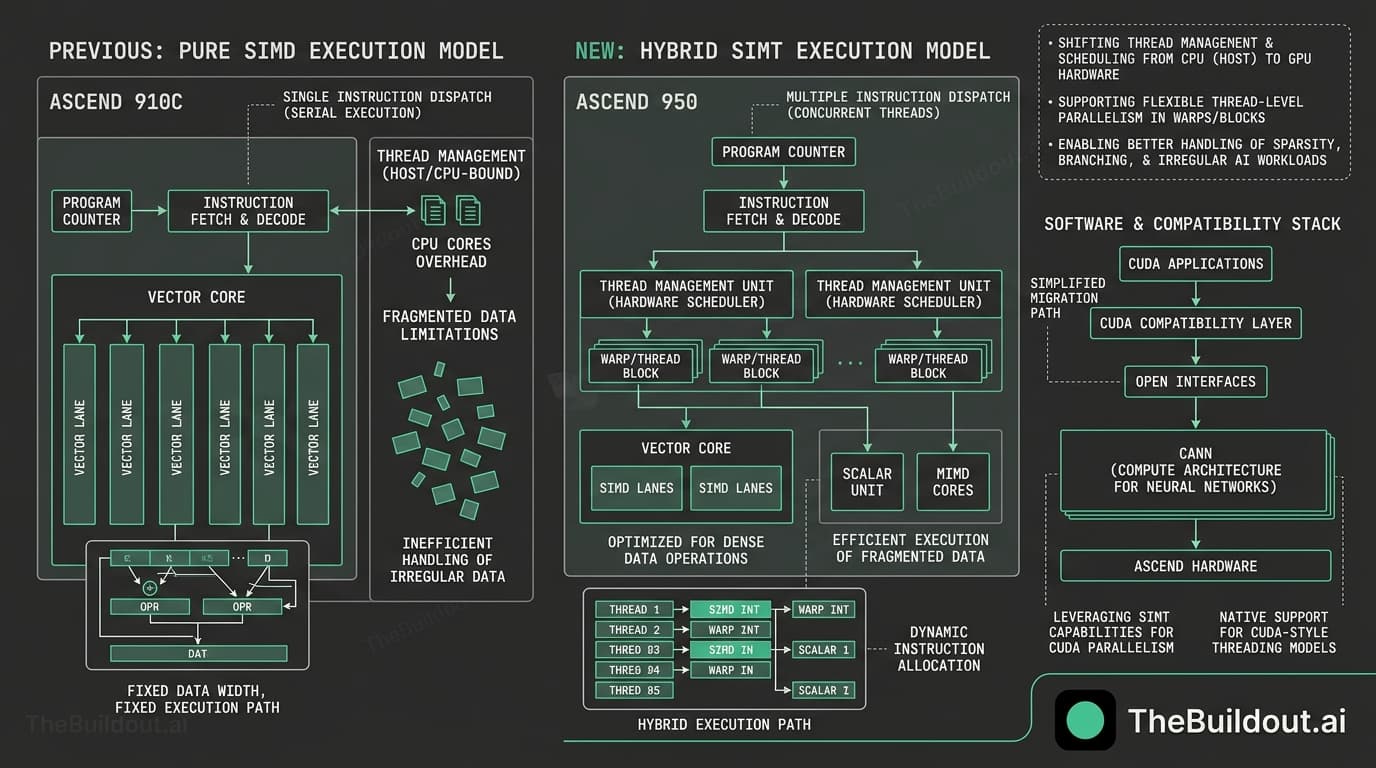
Reports indicate that Huawei has developed a SIMT architecture compatible with NVIDIA's CUDA programming model, potentially easing the transition for software developers to Huawei's AI hardware.
Context
At the Huawei Connect 2025 event, Huawei announced a major architectural shift for its next-generation Ascend 950 series AI chips, introducing a design that combines SIMD and SIMT (Single Instruction, Multiple Threads). This move marks a departure from the purely SIMD architecture used in previous chips like the Ascend 910C. By adopting SIMT, Huawei is moving closer to the architectural model used by Nvidia, which facilitates better handling of fragmented data and improves compatibility with software originally designed for CUDA.
To bridge the gap with Nvidia’s ecosystem, Huawei is also opening the interfaces for its CANN (Compute Architecture for Neural Networks) software stack and moving toward full open-source availability by December 31, 2025. This strategy aims to simplify the migration of AI workloads from CUDA to Ascend hardware. The upcoming Ascend 950 series, expected to hit the market in early 2026, is projected to deliver 2 TB/s interconnect bandwidth as part of Huawei's broader goal to achieve 4 ZettaFLOPS of cluster performance by 2028.
Sources (7)
Huawei charts 6-year Ascend AI chip roadmap, showcasing HBM advances and SuperNode scaleHuawei Research Issue 6Huawei Ascend NPU roadmap examined — company targets 4 ZettaFLOPS FP4 performance by 2028, amid manufacturing constraints | Tom's HardwareGroundbreaking SuperPoD Interconnect: Leading a New Paradigm for AI Infrastructure - HuaweiServing Large Language Models on Huawei CloudMatrix384Can Huawei Take On Nvidia's CUDA?ModelArts - Lite Server User Guide - Huawei Cloud
Related Companies
Nvidia
NVDA