News
Micron completes 236-layer NAND ramp and prepares Hirasawa plant for 9th generation transition
Sunday, March 29, 2026 at 10:01 AM
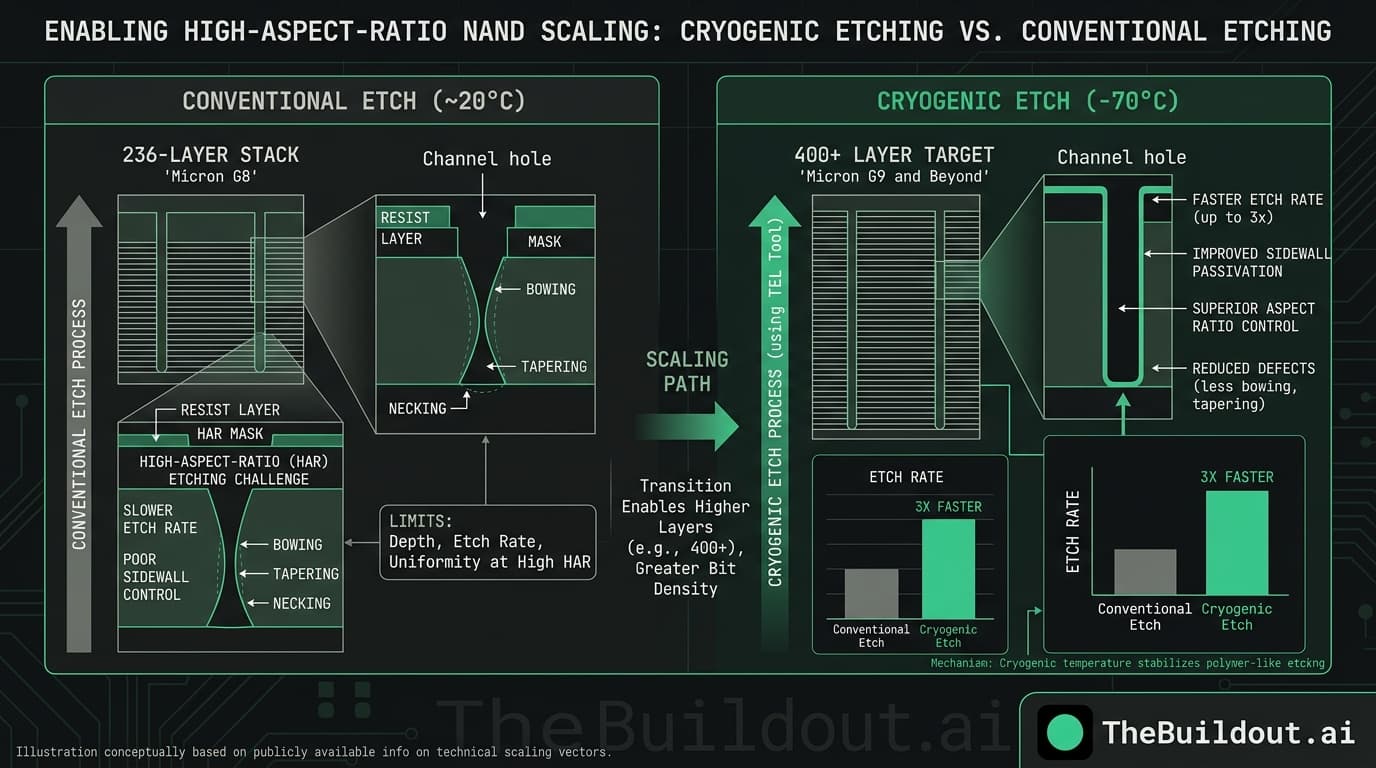
Micron has completed the production ramp of its 236-layer QLC NAND process, which will serve as the primary technology for its SSD lineup. Operations at the Hirasawa plant are now expected to transition to the 9th generation (G9) NAND. This transition likely involves the deployment of Tokyo Electron's advanced cryogenic etching equipment to facilitate high-aspect-ratio hole etching in the next-generation memory stacks.
Context
Memory giant Micron has successfully completed the production ramp of its 236-layer (G8) NAND, a critical milestone for its high-density QLC SSD lineup. As the company transitions its Hirasawa facility to 9th-generation (G9) NAND production, it is increasingly focusing on the world's first 3.6 GB/s transfer rate memory. This transition is expected to leverage Tokyo Electron's advanced cryogenic etching technology, which operates at -70°C to enable the high-aspect-ratio drilling required for next-generation stacks.
This shift is significant as the industry moves toward 400-layer architectures and beyond. Tokyo Electron's new tool reportedly etches up to three times faster than conventional methods while reducing energy consumption by 40%. By adopting these cryogenic processes, Micron aims to maintain its density lead over competitors like Samsung and SK Hynix, particularly as enterprise demand for high-capacity AI storage and PCIe Gen6 SSDs accelerates through 2026.
Sources (10)
G9 NAND | Micron Technology Inc.Cryogenic Etching - Tokyo Electron’s “Digital and Green Transformation” of Semiconductor Process Equipment | Blog | Tokyo Electron Ltd.Samsung Electronics announced this week that it will start mass ...Samsung announces mass production of 236-layer 3D NAND3D flash memory manufactured at -70C with next-gen tool[PDF] Conference Program - SC13Contemporary Challenges in van der Waals 2D Semiconductors | ACS NanoSamsung may release its first 236-layer NAND flash chips this year
Related Companies
Micron
MU
Tokyo Electron
8035