News
Nvidia H200 and Rubin architecture production lines show no overlap in node or packaging capacity
Thursday, March 5, 2026 at 11:57 AM
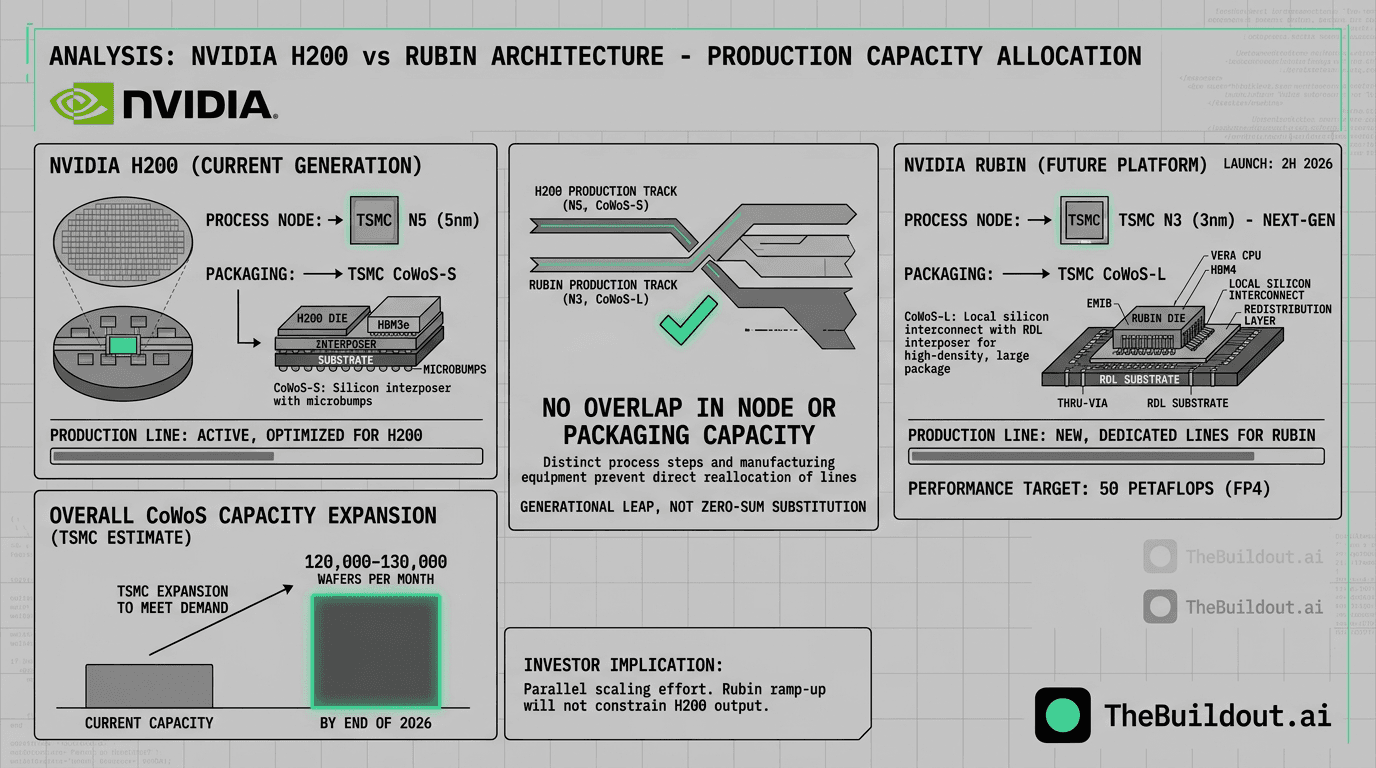
Nvidia's H200 AI chips utilize the N5 manufacturing process and CoWoS-S packaging, while the upcoming Rubin architecture is set to use the N3 process and CoWoS-L packaging. These differences indicate that the production capacities for the two chip generations do not overlap, contradicting recent media reports suggesting resource competition between these nodes.
Context
Recent reports suggesting that Nvidia is shifting production capacity from its H200 chips to the upcoming Rubin architecture may stem from a misunderstanding of TSMC’s manufacturing tiers. The H200 is built on the N5 process node and utilizes CoWoS-S packaging, whereas the Rubin platform—scheduled for a 2H 2026 launch—will migrate to the advanced N3 node and CoWoS-L packaging. Because these architectures occupy distinct process lines and packaging specifications, there is virtually no overlap in the specific production resources they require.
While TSMC is aggressively expanding its total CoWoS capacity to reach an estimated 120,000–130,000 wafers per month by the end of 2026, the hardware transition for Nvidia represents a generational leap rather than a zero-sum reallocation of existing lines. The Rubin platform will feature the Vera CPU and HBM4 memory, aiming for a significant performance increase to 50 petaflops in FP4. Investors should view these developments as parallel scaling efforts rather than a capacity-constrained substitution of current-generation hardware.
Sources (12)
NVIDIA Kicks Off the Next Generation of AI With Rubin — Six New Chips, One Incredible AI Supercomputer | NVIDIA NewsroomH200 Node Provisioning — NVIDIA DGX SuperPOD: Deployment Guide Featuring NVIDIA DGX A100 and DGX H100 SystemsH200 GPU | NVIDIAInside the NVIDIA Rubin Platform: Six New Chips, One AI Supercomputer | NVIDIA Technical BlogCoWoS® - Taiwan Semiconductor Manufacturing Company LimitedPhysical AI: robotics are poised to revolutionise businessNvidia halts China-bound H200 output, shifts TSMC capacity to Vera Rubin, FT reports | ReutersUnveiling the Real Bottlenecks of TSMC
Related Companies
TSMC
2330
Nvidia
NVDA