NewsUnverified
China's semiconductor equipment localization rate grows from 4% to 21% amid trade restrictions
Monday, March 23, 2026 at 09:06 PM
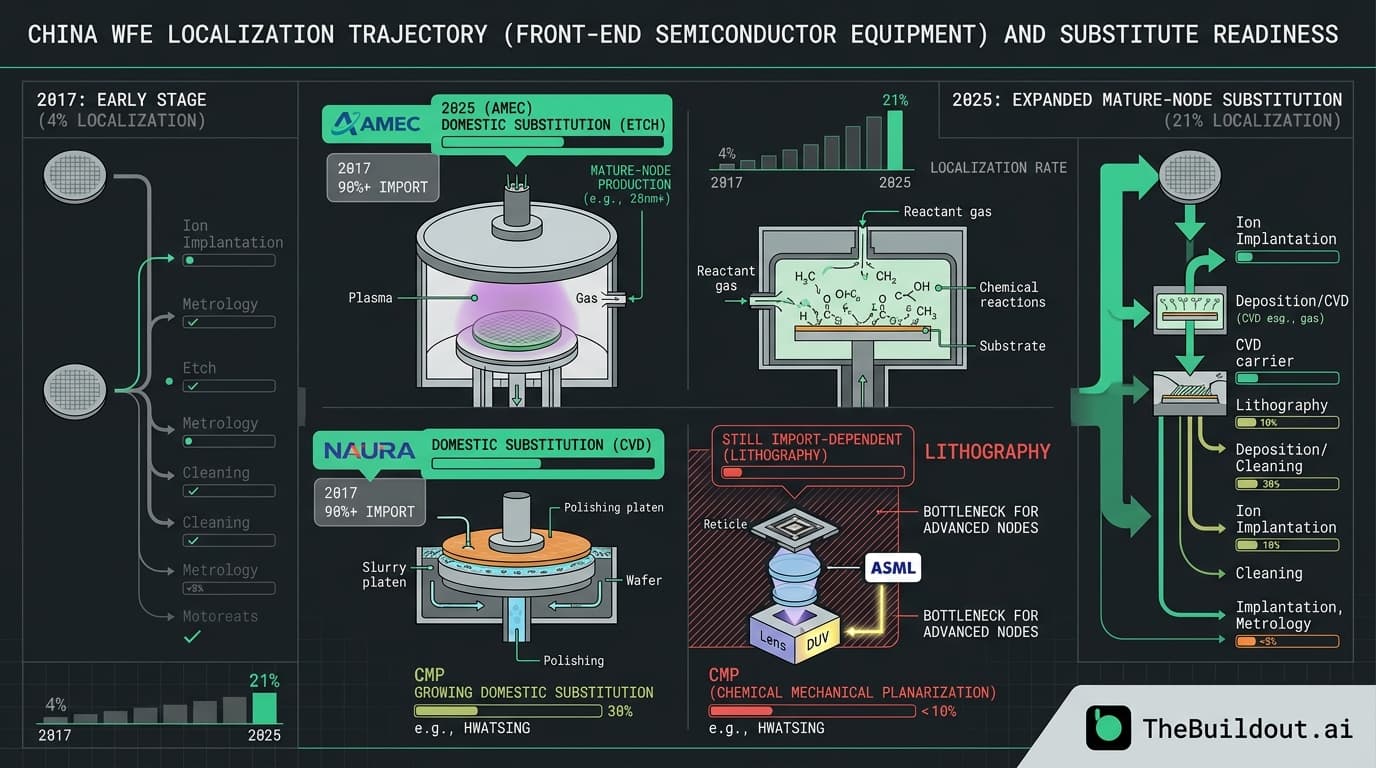
A report by MIR Databank indicates that China's localization rate for front-end semiconductor manufacturing equipment has significantly increased from 4% in 2017 to a projected 21% by 2025. This acceleration in domestic production is a response to ongoing export controls imposed by the United States, Japan, and the Netherlands, which target advanced manufacturing tools including ASML's lithography systems. The trend aligns with China's long-term 'Made in China 2025' industrial policy focused on semiconductor self-sufficiency.
Context
China’s semiconductor equipment localization rate has surged from 4% in 2017 to 21% by 2025, according to data from research firm MIR. This rapid growth follows a series of U.S. trade restrictions initiated in 2019, which effectively forced Chinese manufacturers to accelerate the 'Made in China 2025' goal of self-sufficiency. While the Netherlands and Japan joined U.S. efforts to block advanced tools like ASML’s EUV lithography systems, these barriers have primarily served as a catalyst for domestic investment in 'good enough' technologies for mature-node production.
Key domestic players such as NAURA Technology and AMEC are leading this transition, with NAURA now ranked among the world's top 10 equipment vendors. In a recent analysis, Jean-Christophe Eloy, founder of Yole Group, noted that while Western and Japanese vendors grew by roughly 10% annually over the last five years, "Chinese WFE manufacturers have been growing by 30 to 40 percent." As of March 2026, this trajectory suggests that while China remains years behind the leading edge, its control over foundational and mature-node capacity is expanding at a rate that significantly outpaces global demand.
Sources (12)
China Is Cracking the Global Market for Chip Making Equipment - Semiconductor DigestSemiconductor industry in China - WikipediaChinese fabs are reportedly upgrading older ASML DUV lithography chipmaking machines — secondary channels and independent engineers used to soup up Twinscan NXT series | Tom's HardwareNews-Another Year of Decline: When Will the Servo Market ...Greater China Industrials 2Q25 MIR automation dataChina Semiconductors 2024 Review & 2025 Outlook | PDF | Stocks | Semiconductor Device FabricationChina Semiconductor Manufacturing Equipment Market Size & Outlook, 2033Taking Stock of China's Semiconductor Industry
Related Companies
ASML
ASML