News
Apple follows Nvidia in adopting inflationary export strategy amid shifting supply chain dynamics
Thursday, April 2, 2026 at 09:59 PM
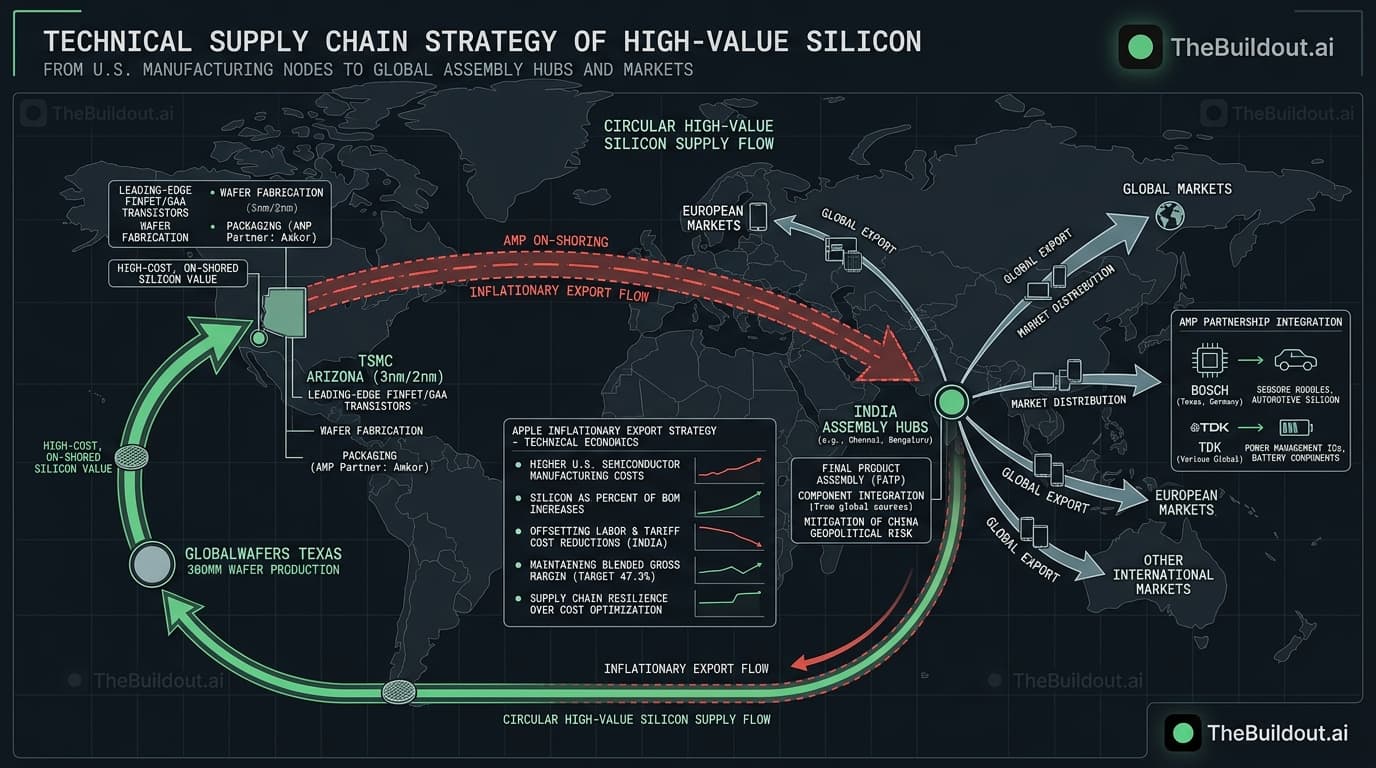
Apple has reportedly adopted an inflationary export strategy similar to Nvidia's, as the semiconductor supply chain increasingly shifts toward a capital-intensive competitive model.
Context
In a major shift toward domestic production and supply chain resilience, Apple has announced a significant acceleration of its U.S. investment, now totaling $600 billion over the next four years. Central to this strategy is the new American Manufacturing Program (AMP), which aims to onshore critical component production. Following a similar logic to Nvidia, Apple is leveraging an inflationary export strategy where components manufactured at high-cost U.S. sites, such as TSMC in Arizona and GlobalWafers in Texas, are exported globally. This capital-intensive transition is evidenced by Apple's recent expansion of its AMP partners to include Bosch and TDK, with an additional $400 million committed to these specific programs through 2030.
Simultaneously, Apple is diversifying its final assembly to mitigate geopolitical risks and tariff pressures. By the end of 2026, the company aims to produce the majority of iPhones sold in the U.S. within India rather than China. This dual-track approach—onshoring high-value silicon and hardware engineering to the U.S. while scaling India as a primary export hub—reflects a fundamental shift in the semiconductor and electronics supply chain. With the launch of the iPhone 17e at a $599 price point on March 2, 2026, Apple is attempting to maintain its 47.3% gross margin while navigating a complex global landscape of shifting manufacturing costs and trade barriers.
Sources (7)
Apple increases U.S. commitment to $600 billion, announces ambitious program - AppleApple moving to make most iPhones for US in India rather than China, source says | ReutersApple India assemblers shift most iPh... - Mobile World LiveApple's Shift to India Boosts Smartphone ExportsHas Apple Shifted Strategy Towards Affordability - Kavout[PDF] Apple Supply Chain 2025 Progress ReportApple's Strategic Shift: Onshoring Supply Chain with Major US ...
Related Companies
Nvidia
NVDA
Apple
AAPL