News
Tesla emphasizes vertical integration strategy for custom chip design and AI infrastructure
Friday, March 20, 2026 at 03:39 AM
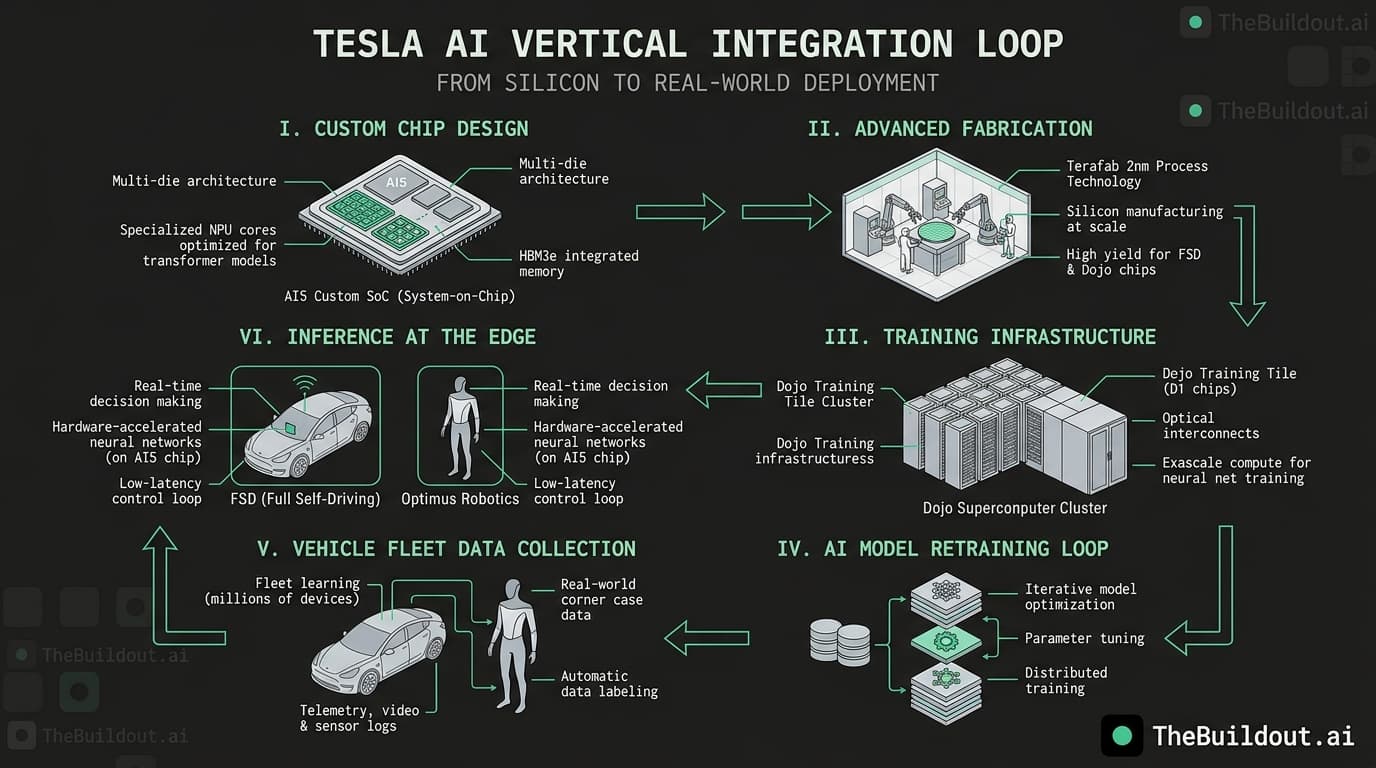
Tesla highlights its vertical integration in AI, encompassing in-house chip design, hardware manufacturing, large-scale data collection, and AI model training.
Context
As of March 2026, Tesla is aggressively expanding its vertical integration strategy, moving beyond vehicle assembly to control the entire AI and semiconductor stack. The company has confirmed the launch of the Terafab Project on March 21, 2026, a massive $25 billion chip fabrication facility designed to secure its supply chain for the future. This move aims to produce between 100 billion and 200 billion custom AI and memory chips annually, utilizing advanced 2-nanometer process technology to support the next generation of Full Self-Driving (FSD), Cybercab, and Optimus robotics. This infrastructure pivot addresses critical supply constraints previously faced when relying on external vendors like TSMC and Samsung. By designing its own AI5 chips and training hardware like the Dojo supercomputer, Tesla seeks to optimize performance-per-watt for real-world vision tasks. The strategy positions Tesla not just as an automaker, but as a leading AI infrastructure provider capable of scaling compute at a volume that rivals traditional semiconductor giants.
Sources (11)
AI & Robotics | TeslaElon Musk told Nvidia to ship AI chips reserved for Tesla to X, xAIA $25 Billion Moonshot: Tesla Prepares To Launch Terafab In Four DaysMusk: Tesla, xAI to keep buying Nvidia AI chips - Tech in AsiaTesla Dojo - WikipediaTesla AI Capacity Expansion – H100, Dojo D1, D2, HW 4.0, X.AI, Cloud Service ProviderTesla Terafab Project: Elon Musk Confirms Launch in Seven Days - FinTech WeeklyTesla's Dojo Supercomputer Breaks All Established Industry Standards — CleanTechnica Deep Dive, Part 4 - CleanTechnica
Related Companies
Tesla
TSLA