News
NTT targets European standardization for IOWN photonics-electronics convergence technology
Wednesday, March 4, 2026 at 08:35 PM
NTT is seeking to establish its IOWN (Innovative Optical and Wireless Network) platform as a global standard starting with Europe. The technology focuses on photonics-electronics convergence to drastically reduce power consumption in data centers and semiconductor communication.
Context
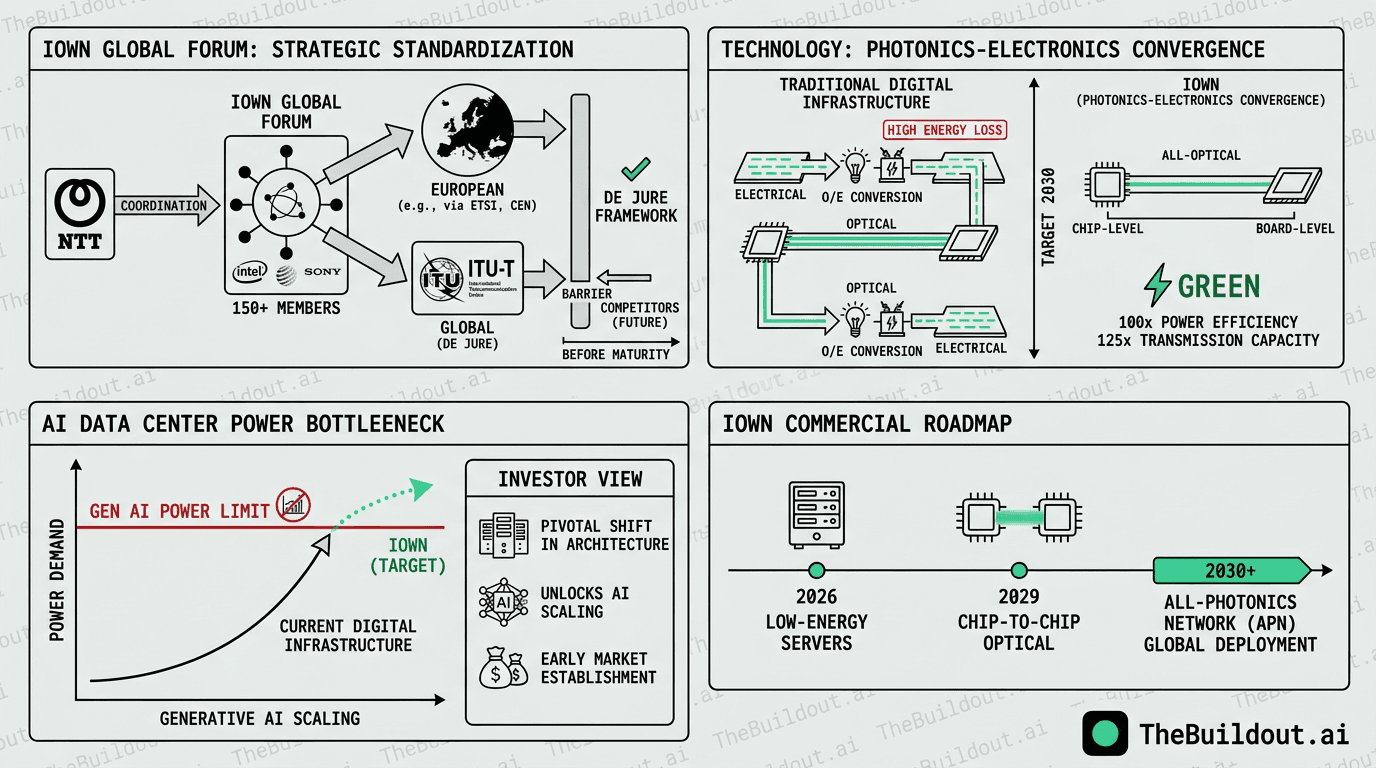
Japanese telecommunications giant NTT is aggressively pushing for European and international standardization of its Innovative Optical and Wireless Network (IOWN). This initiative centers on photonics-electronics convergence, a technology that replaces traditional electrical signals with light-based communication at the chip and board level. By eliminating the energy-intensive conversion between optical and electrical states, NTT aims to achieve a 100-fold increase in power efficiency and a 125-fold increase in transmission capacity compared to current digital infrastructure by 2030.
The move toward European standardization, coordinated through the IOWN Global Forum and ITU-T, is a strategic effort to establish a de jure global framework before competing technologies mature. This is critical for the semiconductor supply chain, as NTT plans to introduce commercially feasible low-energy servers by 2026 and chip-to-chip optical connectivity by 2029. For investors, this represents a pivotal shift in AI data center architecture, targeting the massive power bottlenecks currently limiting generative AI scaling.
Sources (7)
Dissemination Activities | IOWNNTT DATA Establishes IOWN Global Promotion Offices in North America and EMEAL | NTT DATA GroupLatest Activities in the IOWN Global Forum | NTT R&D WebsiteScholarly articles for NTT IOWN European standardization roadmap partnerships -site:seekingalpha.com -site:macrotrends.net -site:tradingview.com -site:marketbeat.com -site:stockanalysis.com -site:tipranks.com -site:simplywall.st -site:perplexity.ai -site:medium.com -site:reddit.com[PDF] Latest Activities in the IOWN Global Forum - NTT Technical ReviewDriving Energy Efficiency and SustainabilityIOWN All-Photonics Network: How NTT Is Rebuilding Communication and Computing Infrastructure with Light - DEV Community
Related Companies
NTT
9432